

Dental Implants vs. Bridgework
Considerations to help you decide what is right for you
Dear Doctor,
I recently had to have a tooth removed and my dentist said the best replacement would be an implant or a three-unit fixed bridge. I am not sure I understand what would be best. Please can you help me?
Dear Colleen,
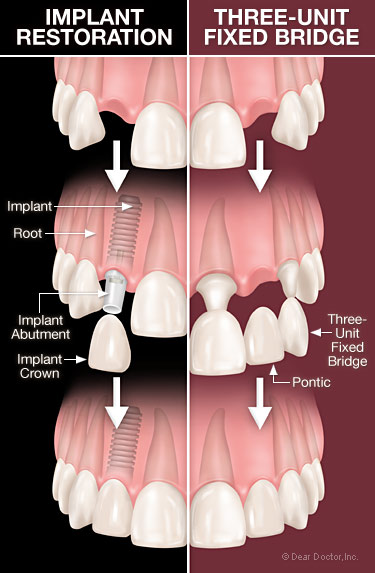
For purposes of this discussion, teeth basically have two main parts; the crown is the part you see in the mouth, and the root is the part that is encased in bone and keeps the tooth in place. A dental implant is actually a root replacement, and unlike the root of a tooth, it is actually fused to the bone of the jaw. A crown is attached to the implant and in effect it becomes a stand-alone tooth, functioning and appearing just like the natural tooth you have lost. The basic prerequisites for a successful implant include:
- a sufficient quantity and quality of bone to anchor or support the implant,
- the adjacent teeth and gums are healthy,
- and the quality of the adjacent teeth will allow for a natural-looking cosmetic result.
By contrast, a fixed bridge is a restoration or prosthesis (replacement part), that is fixed in place by attaching to the natural adjacent teeth. The tooth to be replaced is called a “pontic” after the French “pont” for bridge. The adjacent teeth, called abutments, just like a bridge spanning a river or canyon, provide support on either side. The way that the bridge attaches is that the abutment teeth are “prepared” by removing the enamel layer and are replaced by crowns (caps) to which the false tooth (pontic) is attached. Thus a three-unit bridge is three crowns joined together with the middle crown being a false tooth, with the side crowns cemented or bonded to the adjacent natural teeth.
The following illustration shows the general advantages and disadvantages of a three-unit fixed bridge versus an implant restoration. Please note these are general guidelines only. A discussion with your dentist is necessary to discuss your specific situation. Please see your dentist to review all the risks, benefits and alternatives to determine which option is best for you.
 Advantages of Dental Implants
- Esthetic, functional, predictable, reliable
- Does not affect adjacent teeth
- Does not decay
- Less likely to develop gum disease
- More expensive
- More planning time
- Requires minor surgery
- Requires healing time before permanent tooth replacement
- Esthetic, functional, predictable, reliable
- Less costly
- Requires less time for final result
- Requires enamel removal of adjacent teeth
- If adjacent teeth have crowns, they must be redone
- Tooth decay is potential problem
- Root canal treatment may be required if nerves are affected
- Greater tendency for gum disease
- Less longevity than implants