


Stress & Tooth Habits
Teeth grinding habits related to stress
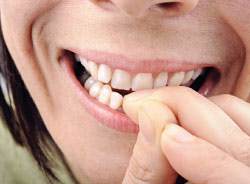
Dear Doctor,
I have been waking up recently with aching teeth and sore jaws; I've also noticed that I'm gritting my teeth a lot during the day. I'm getting married soon and am kind of stressed. Anything I can do to stop this?
Dear James,
What you're experiencing is not uncommon. Teeth grinding and/or clenching habits are quite common and more often than not are associated with stress or sleep deprivation. More-over they may be subconscious, noticed only by a sleeping partner because grinding teeth can be quite noisy (kids do it a lot when they're shedding their baby teeth), or its pointed out by a dental professional having caused excessive tooth wear.
That leads to the next important point; these habits are called “Parafunctional” (para-outside, function – normal), well outside the normal range. In parafunction, biting forces are increased in both magnitude and frequency to over ten times normal; this is when they can become damaging. These habits are commonly seen as clenching or grinding, generally “bruxing” (gritting) of the teeth for prolonged time periods, so called tooth to tooth habits. Parafunction can also manifest as tooth to soft tissue habits, such as thumb sucking or abnormal tongue posture habits; and tooth to foreign body habits such as biting on pencils or nails.
Bruxing or gritting habits are commonly seen in individuals who are undergoing stressful periods or major changes in their lives, like getting married!
They can affect virtually any part of the oral system; the jaw joints or muscles resulting in pain and spasm; the teeth themselves resulting in wear, fractures or looseness; and the associated structures where these habits manifest as headaches, earaches, neck and even backaches.
Bruxing or gritting habits are commonly seen in individuals who are undergoing stressful periods or major changes in their lives, like getting married! The funny thing about stress is that it affects people differently, and sometimes manifests as back pain, stomach ulcers, skin breakouts and the like in other people. Parafunction — tooth grinding habits are what we see in dentistry — a lot. The point is that this is just the way you are reacting and when you're stressed again the same symptoms are likely to recur.
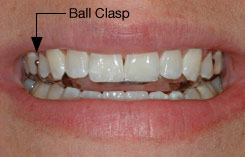 |
| Figure 1: A photograph of a patient wearing a hard acrylic nightguard. Notice the ball clasps that are used for increasing retention. |
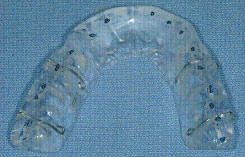 |
| Figure 2: A night guard which has been custom fit to the patient's upper jaw. The black dots indicate the contact of the lower teeth when the patient is wearing the appliance. |
| Photos provided by Dr. David L. Guichet |
The question is what can be done to help. Treatment most often is aimed at relieving the symptoms and stopping damage. For pain and muscle spasm mild anti-inflammatory and muscle relaxant drugs are prescribed initially, and occasionally medication to assist in sleeping. Warm or cold compresses applied in the area of the jaw joints are also helpful. In some severe and unrelenting cases biofeedback, along with psychotherapy is helpful.
Your dentist will often recommend the provision of a night or occlusal (bite) guard. This is usually a hard “processed acrylic” (wear resistant plastic) guard that is quite unobtrusive. It is made to fit over the biting surfaces of the upper teeth only. It is adjusted by the dentist so that it is only a few millimeters in thickness (thinness is a better word), so that the lower teeth are free to glide or skate on the guard and this prevents them from biting into the upper teeth, thereby resting the muscles and stopping the pain. It may be that you will need to use the guard nightly or even during the day when the habit or symptoms are evident and if/when they recur.
A component of the problem may be related to abnormalities like malocclusion (a bad bite or jaw relationship) which can sometimes trigger these kinds of habit patterns. If your main problem is related to a malocclusion then orthodontic treatment (moving the teeth with braces) or bite adjustment by equilibration (minor reshaping of the teeth to even the bite), may be needed.
These and other factors involved cannot be discussed fully in this brief overview. It is therefore very important that you see your dentist to check out what's really going on and that nothing more serious is being overlooked. You can then consider the above alternatives with your dentist.
Best wishes for a great future and don't worry, this should be fixable.

