


Sensitive Teeth
The “ouch” can range from a twinge to downright excruciating
Dear Doctor,
My teeth are really sensitive to hot and cold, especially the tooth that I just had filled. I can't even eat ice cream anymore which is my favorite dessert. What can I do?
Dear Ali,
It sounds like you have generalized sensitivity from many teeth, and possibly the one you had filled recently may be the worst. Let's see if we can provide some direction to help you deal with this problem.
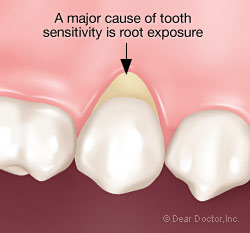
Tooth sensitivity is largely caused by exposure of a tooth's dentin. The enamel covering of the tooth is inert; that is it has no nerve supply and therefore protects the teeth from temperature and pressure changes. When dentin is “exposed” (most often caused by gum recession), the dentin, which contains nerve fibers, will let you know that it is responding to heat, cold or touch the only way that it knows how — by saying “ouch.” That “ouch” can range from a twinge to downright excruciating.
Brushing: Sometimes Too Much of a Good Thing
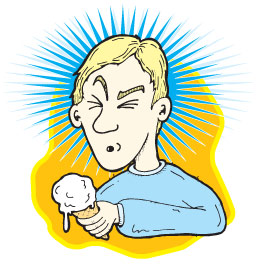
The causes of recession can vary, but a common one is an excessive and improper brushing technique, especially for individuals with genetically thin gum tissues. Once exposed, the dentin of the root surfaces can become vulnerable to erosion by acids and irritation from sweets, primarily in the form of sugars. Ice cream is a “double whammy” — it causes sensitivity from the combination of both cold and sweet. Worn and hard bristle toothbrushes, citrus fruits, sodas, candies and many other things can irritate dentin once exposed.
Ice cream is a “double whammy” — it causes sensitivity from the combination of both cold and sweet.
The mechanism of tooth sensitivity is still being investigated. The dentin consists of tiny little tubules which contain living cells encased in a hard bone-like substance of the dentin. It's thought that pain is felt by “transduction” (trans = through; duct = tube), by differences in pressure set up from the outside of the tooth to the inside — the pulp.
Decay, of course, can also cause tooth sensitivity. As the destructive process of decay works into the structure of a tooth, it finally invades the pulp chamber containing the nerves, increasingly irritating them and escalating the level of pain. If the nerve becomes infected and dies, the acute pain can be very severe, second only to having a baby or passing a kidney stone, or so we've been told.
The removal of decay prior to placing a filling can lead to sensitivity. For this situation, a dentist may typically place a lining or desensitizing material to protect the tooth from sensitivity; however, it may take a while, from a few days to a week, for the tooth to calm down. As teeth age they tend to become naturally less sensitive as more dentin is laid down inside the tooth, which is called “secondary dentin.” This causes the pulp to constrict and get smaller. As a result of this process, the dentin thickens and becomes less permeable reducing sensitivity. Ice cream may once again be enjoyable.
Taking Steps to Minimize Sensitivity
So what can you do about it? First, don't brush the affected teeth too hard or too often — or even try stopping for a few days and see if it helps. The goal of brushing is quite simple: to remove plaque. This only requires a very gentle action with a soft brush.
Second, use a toothpaste containing fluoride. Fluoride increases the strength of the tooth surfaces and makes them more resistant to attack by acids, sweets and excessive brushing. You should actually use the fluoride toothpaste like an ointment so that it's in contact with the affected site in a more concentrated way and for a longer time period than when brushing. There are toothpastes on the market containing potassium products for sensitivity, but studies show their effectiveness is quite variable.
Another treatment for dentin sensitivity is really aimed at applying a barrier to cover the sensitive areas. These barriers range from concentrated, professionally-applied fluoride varnishes to filling materials that are chemically bonded to cover and replace lost tooth structure.
As teeth age they tend to become naturally less sensitive.
If the sensitivity of the tooth you just had filled does not improve and becomes more painful, endodontic or root canal (endo – inside, dont – tooth) treatment may be necessary. This is because increasing sensitivity resulting in pain from heat and biting, or prolonged pain from exposure to cold, may be signs that the pulpal (nerve) tissue inside the tooth is irreversibly damaged.
If the sensitivity persists, you should see your dentist for a more detailed diagnosis, so the cause can be located, understood and treated effectively.

